
Releases & Documents
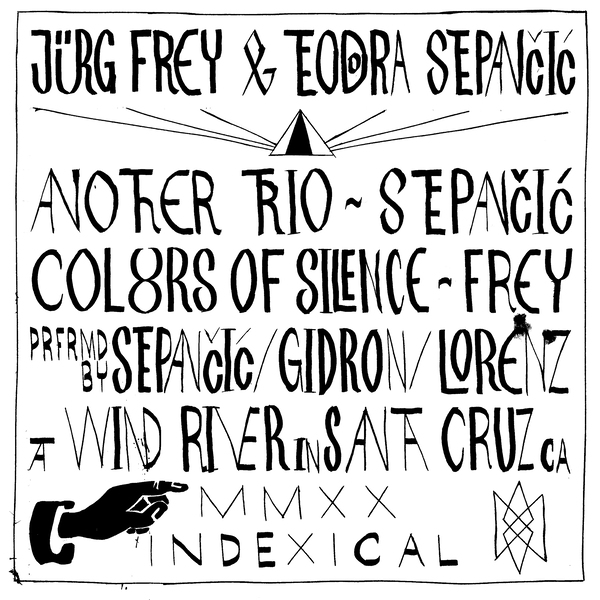
Teodora Stepančić, Assaf Gidron, Martin Lorenz: Two Trios
Two Trios (INDEX-7) is the second release by the trio of Teodora Stepančić, Assaf Gidron, and Martin Lorenz, featuring new work by Stepančić alongside Swiss composer Jürg Frey of the publishing outfit Edition Wandelweiser. Recorded almost entirely without edits in February 2019 in the single-room Wind River Studio in the Santa Cruz Mountains by composer David Dunn, the pieces on Two Trios open themselves to the environment and the outside world, existing alongside the incidental sounds of the room and the forest just outside. Teodora Stepančić’s “Another Trio” (2018) places the physicality of the performers and their materials center stage. The sound of the performers whistling is heard alongside their columns of air rustling sheets of paper or aluminum foil, while the sound from the Casio’s internal speaker is itself sometimes initially obscured by the sound of the performers’ fingers on the keys. Stepančić’s use of the Casio’s auto-rhythm function—a very simple drum machine, restricted to presets like “bossa nova,” or “disco”—immediately recalls the cultural signifiers of a DIY, K Records-esque era: the “environmental sound” of the culture, divorced from its context. There is a kind of paradoxical punk rock aesthetic in this unstrained dashing-off of the quiet sound, the articulated sprezzatura of a noise on the edge of silence. Jürg Frey’s “Colours of Silence” (2017/2018) is a new work composed specifically for the ensemble’s 2019 tour and recording session. “Colours of Silence,” performed on an array of conventional percussion instruments, Casio keyboards, and stones, is marked by Frey’s characteristic fusion of noise and tone. Frey creates “chords” of sound, without the hierarchy of pitched instruments atop percussion of conventional classical music. There are layers of distance and intimacy in Frey’s work: one ear up against the drum head, or alongside the stones, with another ear listening to the tones of the Casio keyboard from what sometimes seems like across the room. “Colours of Silence” is a monumental, substantial work that comes in waves and rewards repeated listening to all layers of the sound and composition.
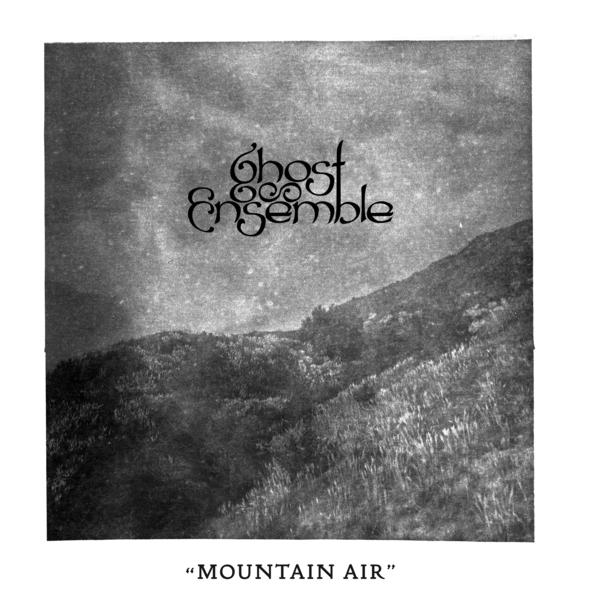
Ghost Ensemble: Mountain Air
Mountain Air (INDEX-8) is the second full-length release by Ghost Ensemble, and features the first commercially available recording of Pauline Oliveros’s “Mountain Air,” composed in 1992. The work, originally conceived as “Arctic Air” for the Fairbanks Symphony Orchestra, changes title to reflect the performance environment; this release was recorded at the studio Wind River in the Santa Cruz Mountains. Oliveros’s work is followed by works commissioned by the ensemble between 2016-20, composed by Teodora Stepančić and Marguerite Brown, and recorded in Santa Cruz during Ghost Ensemble’s 2018 and 2020 tours. Oliveros’s “Mountain Air (Arctic Air)” asks the musicians to alternate among performance techniques interacting with the air and ear. As the composer writes, “I have always been fascinated with the phenomena of hearing just inside the ear and just outside the ear. I am also fascinated with the different qualities of air and how it affects hearing. Thin air, thick air, Arctic air, tropical air — all are different … the focus of attention in Arctic Air is to remain on air and ear throughout the performance.” In live performance, the musicians “drift around very slowly, playing very close to the ears of audience members at times.” In this recording, the players treat the microphones themselves as ears, creating proximity effects that approach auto-sensory motor response (ASMR) triggers. The recording environment itself is open to the outside world, letting in the ambient sounds of birds from the forest just outside the recording studio. The instrumental component of the work is interwoven with a recitation of Oliveros’s wide-ranging landmark text “The Earthworm Also Sings,” read here by composer Laura Steenberge. Marguerite Brown composed “Nonet” for the ensemble’s 2020 tour, featuring a shifting, spectral array of techniques for the instrumentalists. The work moves frame by frame, with sustained chords or figures on each measure that leave some degree of rhythmic placement and interpretation to the performers. Prior to this work, Brown studied at Cornish College of the Arts in Seattle, and worked with Larry Polansky and David Dunn at UC Santa Cruz. Her work frequently employs just intonation and unstable timbral fluctuations. Teodora Stepančić’s “Harp N Ropes (No. 4),” commissioned by Ghost Ensemble in 2016 and recorded live in 2018, finishes the album. In this work — one of a series in which ropes are attached “to instruments and musicians; sometimes to the audience, as well” — fishing line is threaded through the strings of the harp, and the harp is sounded through bowing of the fishing line by the string players. The ethereal, unstable nature of the resulting sound is subtly shifted by the harp player’s changing of pedals, changing the quality of the harmonies while in duo with accordion, before the fishing lines are finally cut, one by one, by the percussionist. Stepančić, based in Brooklyn, is a committed composer, performer, and organizer of new music ranging from work for traditional ensembles to Casio keyboards; her recent work Another Trio is included on another Indexical release this year. Ghost Ensemble is dedicated to experimental music that explores the act of listening, expands perceptual horizons, and encourages a common immersive experience, demonstrating its potential for individual and community transformation. Established in 2012, Ghost emphasizes long-term collaborations with composers to foster groundbreaking music that blurs borders of genre, style, and scene. The ensemble worked closely with Pauline Oliveros until her death in 2016 and continues to champion her work. Critics have hailed Ghost’s debut LP We Who Walk Again, selected among Bandcamp Daily’s “10 Best Contemporary Classical Albums of 2018” and featuring Oliveros’s Angels and Demons alongside works by ensemble members Sky Macklay and Ben Richter, as “prodigious … a thrilling listen” (Carey, Sequenza21), “wonderful work … exhilarating” (Margasak, Bandcamp Daily), “beautifully performed and recorded … a body-felt sound mass … evoking the primeval" (Wilhoite, Meg’s New Music Blog), and “cloudy, mysterious and dark … Beckettian in its slow spread … certainly a group to keep an eye on” (Olewnick, Just Outside).
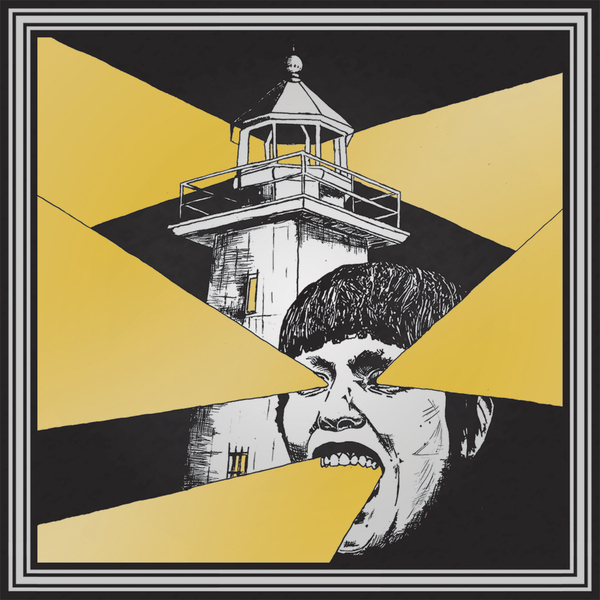
Carmina Escobar: Feast of Beams, Keepers of Light
Feast of Beams, Keepers of Light was a modern day spectacle, tailor-made for the Santa Cruz coastline by vocalist and composer Carmina Escobar. This site-specific work unfolded over the course of many hours, as performers converged on Lighthouse Point in Santa Cruz while bicycling with whistles, dancing with long reflective sheets, singing through megaphones, and surfing with bird calls. The performances drew on through sunset, highlighting features of the landscape and ending with a large-scale group performance and land acknowledgement by artist and activist Catherine Herrera. This booklet is the first extensive written documentation of Escobar’s site-specific practice. In it, she articulates her aims of connecting local communities to their shared public spaces and to one other. Her work raises questions about who is allowed to occupy public space and how, drawing from research into a site’s history so that relationships among people and public spaces are informed by their histories. Escobar’s process traces what curators Madison Heying and Laura Steenberge call “connection across stratification.” Her process acknowledges the layers of interpersonal interactions with the land that leave physical, cultural, and spiritual traces behind. Feast of Beams, Keepers of Light provides a rare lens into the process of creating a site-specific, collaborative work. As Escobar explains in an interview with Heying, the piece is “process-oriented, and the meaningful part of it was the enacting.” This booklet provides a gathering place for Escobar’s collaborating artists to reflect on this process of enacting the work, while also extending the themes of the work into the future. It features an introduction by curators Madison Heying and Laura Steenberge, an interview with Escobar, and contributions from collaborating artists: Paola Escobar, Joshua Gerowitz, Catherine Herrera, Mélodie Michel, Gabriel Mindel Saloman, Laura Steenberge, Micaela Tobin, and K C M Walker. Carmina Escobar is an experimental vocalist, composer, and performer from Mexico City. Escobar currently resides in Los Angeles, CA where she is deeply embedded in the experimental music scene as a an instructor at CalArts, a collaborator and performer in styles ranging from her own site-specific works to group improvisation to contemporary opera, and as an organizer with collectives such as BetaLevel. Escobar is also the co-founder and co-director of the Ensemble LIMINAR, a large contemporary music ensemble that originated in Mexico. Escobar’s prestigious awards include a Foundation for Contemporary Arts Grant, grants from the National Center for the Arts in Mexico, the MID Atlantic Arts Foundation, and the USA Artist International Award. Her work has been presented at the Borealis Festival, Bergen, Norway; Cuban Art Factory, Havana; CTM Festival, Berlin; Machine Project, Los Angeles; MATA festival, New York; REDCAT, Los Angeles; and the World Dada Fair, San Francisco. Feast of Beams, Keepers of Light was the culminating event of an Artist-in-Residence program hosted by Indexical, a Santa Cruz-based nonprofit dedicated to experimentation in music. Indexical has presented performances in Santa Cruz since 2015, ranging from large-scale site-specific works to chamber music and free improvisation. Escobar’s residency was funded in part by Santa Cruz City Arts, the City of Santa Cruz Arts Commission, and an anonymous donor. Proceeds from the Feast of Beams, Keepers of Light booklet will be donated to the Amah Mutsun Land Trust, a 501©(3) nonprofit organization working to restore indigenous knowledge and land stewardship practices in the south-San Francisco and north-Monterey Bay areas. Currently, the Amah Mutsun Land Trust is working to protect Juristic, their most sacred site, from the proposed Sargent Ranch Quarry project. This project threatens critical wildlife habitat, as well as the cultural and spiritual center of Amah Mutsun territory. Learn more about this campaign at protectjuristac.org. Conceived by Carmina Escobar Collaborating Artists: Gabriel Mindel Saloman, Micaela Tobin, Melodie Michel, Paola Escobar, K C M Walker, Joshua Gerowitz, Laura Steenberge, Catherine Herrera Madison Heying & Laura Steenberge, editors Mustafa Walker, designer David Kant, field recording
the real world / pile of debris
A compilation of live recordings presented by Indexical in Santa Cruz, California, throughout 2019. Mixing & Mastering: David Kant Cover Image: Keanu Ramos

The Essential Indexical: Early MMXVIII
The Essential Indexical a thrice-yearly digital release of new and experimental work presented by Indexical. The Essential Indexical: Early MMXVIII includes performances from Indexical’s 2018 Santa Cruz concert series, from January through March of 2018.
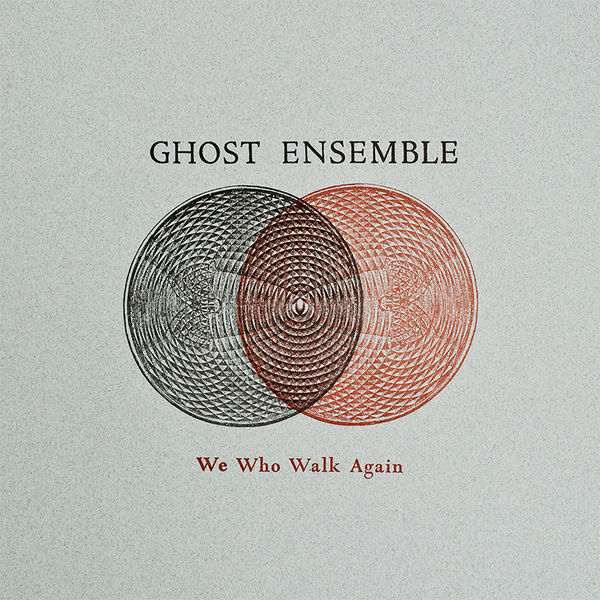
Ghost Ensemble: We Who Walk Again
Ghost Ensemble began in 2012, dedicated to new perspectives that explore the experience of listening. The music we create and perform realizes a wide spectrum of sonic spaces and engages performance practices between and beyond improvisation and fully measured notation; the common thread is an aim to shift our attention, perception, or experience of time. We traverse these waters because there seems something magic in them. Many of these works share a meditative practice or an inclination toward altered consciousness or metaphysical exploration. Intuitive processes, fragile and liminal sounds, and fluctuating or non-predictable pitch relationships combine to distort our time perception and foster rapt, engrossed attention in the present moment. By expanding our horizons and perceptions and encouraging immersive experience, by renewing our spirits, this music demonstrates its potential as a real healing force. The works and Deep Listening practice of Pauline Oliveros have been central to the ensemble’s identity since its conception. In 2013, Ghost Ensemble, Oliveros, and the Deep Listening Institute celebrated the 2013 release of her Anthology of Text Scores together at Eyebeam. Her warm, generous, fearless, and mischievous spirit helped instill in many of us a boundlessly liberating outlook – as she asks in Imaginary Meditations, “Can you imagine listening beyond the edge of your imagination?” The selection of works on We Who Walk Again introduces the core of Ghost Ensemble’s repertoire and the diverse practices our approach hopes to unite. The title invokes the Icelandic legend of the draugr, or aptrgangr, a ghostly being with the power to morph into many shapes, gaze into the future, and enter dreams to bestow gifts on the living – something like a collection of the magical properties, perhaps, of music. Ben Richter, 2018 Critical Praise “wonderful work … serene, rippling waves … stirring, ominous surges of sound … both exhilarating and a bit scary … thrums, throbs, and glides with surging and ebbing density.” (Margasak, Bandcamp Daily (https://daily.bandcamp.com/2018/07/06/best-of-bandcamp-contemporary-classical-june-2018/)) • “Very fine ensemble playing — excellent listening to one another … cloudy, mysterious and dark … Beckettian in its slow spread … a group to keep an eye on.” (Olewnick, Just Outside (https://olewnick.blogspot.com/2018/05/ghost-ensemble-we-who-walk-again.html)) • “Beautifully performed and recorded … keeping you in the present … a body-felt sound mass … a multifaceted texture that evokes the primeval.” (Wilhoite (https://megsnewmusicblog.wordpress.com/2018/09/06/we-who-walk-again-cd-review/)) • “prodigious … considerable dramatic heft … a thrilling listen … well-crafted and eloquent work.” (Carey, Sequenza21 (http://www.sequenza21.com/2018/06/ghost-ensemble-we-who-walk-again-lp-review/)) Ghost Ensemble Alice Jones: flute Sky Macklay: oboe Ben Richter: accordion Chris Nappi: percussion Damon Loren Baker: percussion Lucia Helen Stavros: harp Hannah Levinson: viola Maria Hadge: violoncello James Ilgenfritz: contrabass Rebekah Griffin Green: contrabass Carl Bettendorf: conductor Produced by Andrew C. Smith with Ben Richter and Sky Macklay Engineered by Joseph Branciforte at The Bunker Mastered by Adam Gonsalves at Telegraph Audio Design by Mustafa Walker and Sam Amico Printing by Niche of Light Letterpress Special thanks to the Pauline Oliveros Trust, Carole Ione, Martha Cargo Indexical 2018
The Essential Indexical: Late MMXVII
After sorting through quite a few recordings from the last third of 2017, we’re thrilled to release a compilation of some of the most unique and memorable tracks, with always-glorious artwork by Mustafa Walker.
The Essential Indexical: Mid MMXVII
Indexical announces The Essential Indexical: Mid MMXVII, a compilation of two hours of live and live-in-studio recordings of experimental and new chamber music from Santa Cruz, California. Mid MMXVII spans genres and disciplines, from compositions recorded by the New York-based Mivos Quartet to live electronic sets of atmospheric work by Samson Stilwell and Ashley Bellouin & Ben Bracken, to Weston Olencki’s multi-part piece for five-string bass duo Bass2Bass. Anchoring Mid MMXVII are three performances by Mivos Quartet. Opening the compilation is Martin Stauning’s crystalline Atmende Steine, alongside Mario Diaz de Leon’s propulsive and sonically expansive Moonblood, and a newly revised and expanded version of Anahita Abbasi’s Distorted Attitudes IV / Facile Synthesis. Recorded live-in-studio at Wind River in the Santa Cruz mountains, the atmosphere of the room and the ensemble’s performance channels the energy of a live event. Indexical Co-Director Andrew C. Smith writes that with these “next-day” recordings, “On the occasion that something unique crosses our path, we want the option to get it down.” This is all the more critical for a series focusing on collaborations between performers and composers, as slight changes might need to be made after a premiere performance, and the opportunity to work in a low-stakes but controlled environment can make all the difference. The Essential Indexical: Mid MMXVII https://www.indexical.org/system/images/images/000/000/019/xl/mid17essind-800x1264.jpg?1507225861 The Essential Indexical is a thrice-yearly recording archive and compilation of music from Indexical’s series of experimental and new chamber music in Santa Cruz. Started in 2017, it provides a platform for artists performing in Santa Cruz to reach a global audience. Supported in part by a Bandcamp subscription service, The Essential Indexical allows audiences a chance to discover new work that might not otherwise be made public. Recorded by David Dunn and Daniel Higdon (1, 3, 5) and Indexical (2, 4, 6). Mixed by Joseph Branciforte (1, 3, 5) and David Kant (2, 4, 6). Design by Mustafa Walker.
The Essential Indexical: Early MMXVII
Experimental music is not just about producing a couple high-profile concerts. It’s about the scene. Representing the community through documentation and recorded material is always difficult, but over 10 concerts in the last 5 months, we’ve accumulated such a wealth of recorded material that we can’t help but spend time polishing it and making it available. We’re thrilled to announce a new project: The Essential Indexical, a compilation of live recordings representing some of the artists who have performed on our series in Santa Cruz and elsewhere. Early MMXVII includes the JACK Quartet & Lightbulb Ensemble’s performances of work by Sarang Kim and Peter Sloan, and the debut collaboration of the scorching trio of Zachary James Watkins and RAGE THORMBONES (Matt Barbier & Weston Olencki). We’ve also got work by Ma’ayan Tsadka, David Dramm & Anne La Berge, Happy Valley Band, and Jon Myers & Madalyn Merkey. It’s all available online for a single purchase of $10 or (you might prefer!) a series subscription (https://theessentialindexical.bandcamp.com/subscribe) of $25/year. The Essential Indexical: Tracklist https://www.indexical.org/system/images/images/000/000/015/xl/EssentialIndexical-TrackList.jpg?1495819994
Andrew C. Smith: Larry Polansky’s Piano Study #5 (for Just Fender Rhodes)
We’re thrilled to announce a new series of limited-edition lathe-cut records, single sided, with performances on Side A and screen-printed designs by Mustafa Walker on Side B. The first release is Larry Polansky's Piano Study #5, for just intonation Fender Rhodes, performed by Andrew C. Smith and engineered by David Dunn, with a screen-printed tuning lattice showing through a transparent record. This is one of a few limited-edition items we’re planning to raise funds for ongoing concert productions and operations in Santa Cruz (https://www.indexical.org/posts/the-essential-indexical). Proceeds for this record will go toward ensuring we can continue developing relationships with artists, and fostering ongoing creative collaborations. Edition of 25 signed/numbered copies. Estimated delivery July 2017. Program Notes (April 2016, for a concert at UC Santa Cruz) Piano Study #5 is one of my earliest pieces, written for Fender Rhodes in a non-octave repeating, 13-limit just intonation. It is an improvisation in which the “prime-tonality” of the harmonic fabric slowly evolves. The score comprises the tuning, and simple instructions for moving a folk tune through the harmonic possibilities of the tuning system from lower to higher primes and back again. The piano tuning is: Octave 1 1/1 21/20 9/8 6/5 5/4 4/3 7/5 3/2 8/5 5/3 7/4 15/8 Octave 2 1/1 21/20 9/8 6/5 5/4 4/3 7/5 3/2 8/5 5/3 7/4 15/8 Octave 3 1/1 33/32 9/8 6/5 5/4 21/16 11/8 3/2 8/5 13/8 7/4 15/8 Octave 4 1/1 21/20 9/8 7/6 5/4 4/3 11/8 3/2 8/5 27/16 7/4 15/8 Piano Study #5 has a somewhat unusual history, nicely bookended by tonight’s performance. I wrote this piece in 1975 while an undergraduate at UC Santa Cruz. I borrowed a Fender Rhodes from fellow student Paul Sparrow, an oscilloscope from the electronic music studio, and purchased a monochord from Lou Harrison and Bill Colvig, my first meeting with those lifelong friends. I performed the piece on a concert of 20th Century American Music (1976) for piano, organized by fellow student Steve Key, and then again on my senior recital (1977) in the old Music Department concert hall (now in the Theater Department). Subsequent performances were at Roulette in NYC in 1979 (on a piano loaned to me by Dick Higgins and Philip Corner), and finally at Mills College in 1981. The score was published in Xenharmonikon in 1977, and a short essay about it in 1/1: The Journal of the Just Intonation Network, in 1985. The difficulty of playing the piece (I’m a guitarist, not a pianist), tuning the piano, and the experience of carrying a Fender Rhodes up and down five flights of stairs to my NYC loft on Leonard Street and five or six blocks more to Roulette on Franklin St., discouraged me from continuing to perform the piece after that. I finally recorded it (with Tom Erbe, engineer) on my CD entitled Change (2002, Artifact CDs), and sold my Fender Rhodes. In the original performances, I had used the tune “Rally Round the Flag,” but on the Artifact recording I used “When de Whale Get Strike,” in memory of Bill Colvig. This song is a Bahaman lament for a fallen friend recorded by Alan Lomax (1935) and later transcribed by Ruth Crawford Seeger (1941). It seemed to me possible, when writing the piece some 40 years ago, that anyone with a Fender Rhodes, a deep knowledge of tuning theory and the ability to improvise could perform Piano Study #5. However, to the best of my knowledge, Andrew Smith is the first to do so. Andrew’s advanced skills as a pianist and improviser, his understanding of tuning (and thus the idea behind the piece), and his own compositional creativity revivify this old work in a way that I had only dreamed of. I am extremely fortunate that he has done so, even recording it for the Indexical label (with David Dunn, engineer). Astonishingly, Andrew even seems to enjoy, or at least pretends to enjoy, schlepping the Fender Rhodes. Larry Polansky 2/27/16
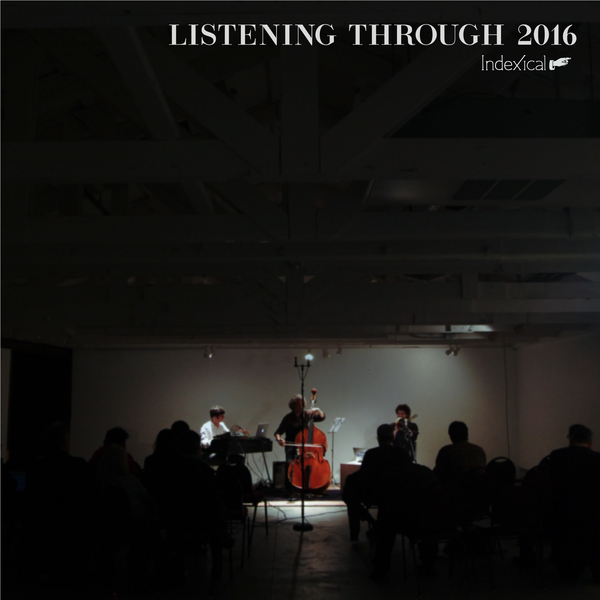
Listening Through 2016
Throughout 2016, Indexical presented a dozen events at Radius Gallery (Santa Cruz), The Invisible Dog Art Center (Brooklyn), and Don Quixote’s International Music Hall and Mexican Restaurant (Felton). This is a small handful of the work that translated best to audio format, and that we were able to record in sufficient quality to share with all of you. We are deeply grateful to the artists for their permission to post these recordings online. Many of these pieces exist in video format as well. Check out our Vimeo page (http://www.vimeo.com/indexical) to see those, or see a few of our favorites below.
Happy Valley Band: ORGANVM PERCEPTVS
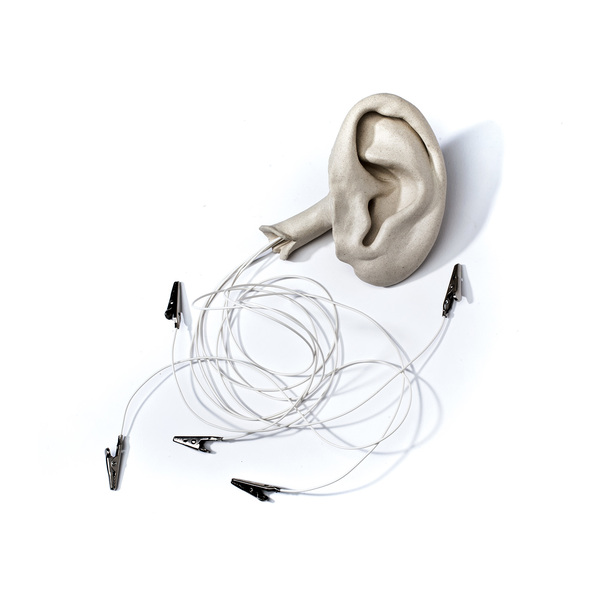
The Happy Valley Band is the Great American Songbook heard through the ear of a machine. Composer / bandleader David Kant uses custom-built machine learning software to “unmix” pop songs and transcribe them back into musical notation. The Happy Valley Band plays what comes out. The machine analysis has no concern for the limits of human performance, and the resulting transcriptions are extremely complex, literal, and often impossible to play. ORGANVM PERCEPTVS, the group’s debut album, is about bringing to life this inhuman music. It features the core Happy Valley Band plus a cast of New York City and Bay Area experimental musicians. The Happy Valley Band has been called “a shitty MP3 to MIDI converter,” “the Shaggs meets Guitar Hero,” “James Brown backed by Sun Ra,” “the best executed worst idea,” and “substantive acousmatic research.” The album, over five years in the making, is a collection of eleven songs spanning pop music history. Imagine James Brown backed by a simmering Sun Ra Arkestra, Madonna with a jittery freak-out synth rhythm section, and Herb Alpert with a Tijuana Brass that must have been led by Charles Ives. As Kant says, “it’s not exactly about getting machines to hear like (we presume) humans do. Machines hear in as many different ways as we design and build them. We should use machines to hear differently, not to reinforce our expectations—because whose expectations are they anyway?” (from “Decomposing Music” liner notes) The project is about confronting the assumptions and idiosyncrasies of machine hearing. In an era where we have offloaded much of our mental and biological processes to semi-intelligent machines, ORGANVM PERCEPTVS asks us to examine the biases and expectations implicit in their design. Included with ORGANVM PERCEPTVS is a print booklet containing liner notes by Kurt Gottschalk and an essay “Decomposing Music” by bandleader David Kant detailing the machine hearing process used to make the music. Booklet https://www.indexical.org/system/images/images/000/000/009/xl/634A0209.jpg?1490138163 Directed by composer / bandleader David Kant, the Happy Valley Band is Mustafa Walker, Alexander Dupuis, Andrew Smith, Beau Sievers, Pauline Kim Harris, and Conrad Harris. The ensemble formed in 2011 at Ostrava Days Festival of New Music specifically to play this music. ORGANVM PERCEPTVS features special guests appearances by Chris Nappi, Joseph Kubera, Thomas Verchot, Gordon Monahan, Joe Moffett, Chris Scanlon, Nathaniel Morgan, Sam Friedman, Daniel Costello, Charlotte Mundy, Jane Sheldon, Eve Gigliotti, Larry Polansky, and John Welsh. Cover, liner notes, spread https://www.indexical.org/system/images/images/000/000/006/xl/FBSingle-Triowith_Madonna.jpg?1490137936 What people are saying Imagine a confused booking agent hiring Sun Ra’s Arkestra as the backup band for James Brown, Brian Ferneyhough doing arrangements for Patsy Cline, Elvis at a Vegas gig with Fishbone, or Neil Young putting words to the Concord Sonata. The Happy Valley Band manages to smash at least a dozen comfortable precepts about our culture and how music is suppose to be made while simultaneously doing substantive acousmatic research. And despite all of this, it sounds absolutely amazing! - David Dunn In the world, this is a world. How can I show you? Your voice can take me there. Peasants singing, drummers drumming, colors flying in the air. Just like a dream, it burns. Why can’t you see what you’re doing to me? I used to feel so uninspired, get down. You make me feel crazy. I’ve been waiting for this moment all my life. - Laura Steenberge The Happy Valley Band are the wily translators of an epic story that tells the tale of the Singularity’s awkward and raucous first encounter with the machinery of Rock and Roll. Our unlikely hero, the Computer, tries desperately to ingest, process and replicate the idolatry of Stardom, but is confronted by its inability to to truly understand the conceptual components of melodic intensity, rhythmic groove and the almighty influence of celebrity. (Think the Shaggs meets Guitar Hero!) - Jessie Marino The Happy Valley Band is not so much a band as it is a concept of a band. They render pop classics at once both listenable and unlistenable, deconstructing arrangements that become avant garde renditions that fold back onto themselves, forming Mobius strip interpretations. In the process, they stretch the limits of song recognition, suddenly springing back to a familiar lyric before veering into the unrecognizable again. - Gordon Monahan Press Interview and Advance stream in The Wire The Wire https://www.indexical.org/system/images/images/000/000/004/xl/wire-screencap.png?1487964766 (http://www.thewire.co.uk/in-writing/interviews/listen-to-the-happy-valley-band-s-new-album-and-read-an-interview-with-its-founder) “refracted and amplified through the software in often mystifying ways, resulting in warped interpretations that are unexpected, to say the least” - Emily Bick, The Wire News Feature in Tiny Mix Tapes Tiny Mix Tapes https://www.indexical.org/system/images/images/000/000/005/xl/TMT-screencap.png?1487964813 (http://www.tinymixtapes.com/news/happy-valley-band-deconstruct-pop-classics-machine-learning-algorithm-debut-organvm-perceptvs) "the latest iteration of pop music’s post-human future… delirious and discordant reworkings of such classics as ‘Like a Prayer,’ ‘Suspicious Minds,’ and ‘Ring of Fire,’ performed by modern experimental and avant/garde luminaries.” - Colin Fitzgerald, Tiny Mix Tapes Credits and Personnel Alexander Dupuis: Guitars Mustafa Walker: Electric and Upright Bass Beau Sievers: Drum Kit Andrew Smith: Piano and Keyboards David Kant: Saxophones Pauline Kim Harris: Violin Conrad Harris: Violin Chris Nappi: Percussion Joseph Kubera: Piano Daniel Costello: French Horn Thomas Verchot: Trumpet and Flugelhorn Joe Moffett: Trumpet Christoper Scanlon: Trumpet Nathaniel Morgan: Alto Saxophone Sam Friedman: Harmonica Charlotte Mundy: Voice Jane Sheldon: Voice Eve Gigliotti: Voice John Welsh: Guitar Larry Polansky: Guitar Composed by David Kant ORGANVM PERCEPTVS was recorded at The Bunker Studio in Brooklyn, NY by Joseph Branciforte and Todd Carder. Mixed by Joseph Branciforte with the Happy Valley Band. Mastered by Cookie Marenco and Patrick O'Connor at OTR Studios. Additional recording engineering by Steve Schwartz and Arvid Tomayko, Ulrike Wentzkat, and David Dunn. Jacket design by Rachel Cassandra, photography by RR Jones, and ceramic sculpture of David Kant’s left ear by Elizabeth Torrance. Madonna portrait by Alexander Dupuis. Booklet layout and design by Mustafa Walker, handwriting by Rachel Cassandra, and cover image by Alexander Dupuis, with support from the University of California Santa Cruz, Arts Dean’s Fund for Excellence. ALL OF THE MUSIC AND NONE OF THE SONGS © 2016 David Kant
Lightbulb Ensemble & Ghost Ensemble Live at Pioneer Works
From a live performance on Oct. 30, 2015, at Pioneer Works in Red Hook, Brooklyn. The Oakland-based Lightbulb Ensemble’s process-based minimalism takes inspiration from the sounds and structures of Balinese gamelan, moving it in a new direction. NYC-based Ghost Ensemble was formed to perform their own music and the music of Pauline Oliveros, and focuses on creating meditative experiences. (#more) This album is pay-what-you will. Any funds will go toward providing future high-quality live recordings of Indexical concerts. Thank you to the artists and composers for making their work available. Ghost Ensemble Founded in 2012, Ghost Ensemble performs experimental music that explores the experience of listening: the familiar can become unfamiliar, while unexpected and unexplored places o er new layers of beauty. Visit www.ghostensemble.org (http://www.ghostensemble.org) for future events. Angels and Demons (1980): The more I listen, the more I learn to listen. Deep Listening involves going below the surface of what is heard, expanding to the whole field of sound while finding focus. This is the way to connect with the acoustic environment, all that inhabits it, and all that there is. Deep Listening takes us below the surface of our consciousness and helps to change or dissolve limiting boundaries. Babies are the best Deep Listeners. Think of the tremendous acts of attention and concentration that babies make to explore sounds and speak their first words, to learn language and communicate through listening. Angels represent the collective guardian spirits of this meditation. Demons represent the individual spirits of creative genius. —Pauline Oliveros Healing Ghost (2013) presents the slowly metamorphosing life cycle of a single sonic location. With a focus on the sensory aspects of the musical experience, the relatively open structure allows each performance to contain unexpected moments and events. —Ben Richter Martha Cargo, flute; Sky Macklay, oboe; Lucia Stavros, harp; Tyler Mashek and Damon Loren Baker, percussion; Hannah Levinson, viola; James Ilgenfritz, bass; Ben Richter, accordion; Nathan Koci, accordion Lightbulb Ensemble Lightbulb Ensemble is a new music percussion ensemble that champions experimental music, instrument building, and contemporary gamelan. The ensemble emerged from the culture of new music in the Bay Area centering around Mills College, and the longstanding artistic exchange between Bali and the US fostered by Gamelan Sekar Jaya. The group performs on steel metallophones, wooden marimbas, and other instruments designed, tuned, and built by Brian Baumbusch, Lightbulb’s founder and director. Performing only new repertoire, the group presents in-house compositions and collaborates with other artists of the new music community. Visit www.lightbulbensemble.com (http://www.lightbulbensemble.com) for future events. Steel-keyed metallophones: Brian Baumbusch, alto+; Wayne Vitale, alto-; Carla Fabrizio, soprano+; Sarah Wilner, soprano-; Daniel Steffey, tenor+; Maurissa Dorn, tenor- Cedar-keyed xylophones: Keener Pepper, baritone+; Scott Siler, baritone-; Lydia Martin, bass+/- Bronze gongs: Sarang Kim, pencon 1; Lucas Helland, pencon 2; James Iwamasa, gongs James Clark, live and recording engineer Andrew C. Smith, mixing

Index 0
Index 0 showcases new work for strings, piano, and electronics from six young American composers: Elizabeth Adams, Jack Callahan, Stephanie Huguenin, Beau Sievers, Andrew C. Smith, and K.C.M. Walker. Their compositions are performed by avant-garde violin duo String Noise (Conrad Harris and Pauline Kim Harris) with violist Dov Scheindlin (Orpheus Chamber Orchestra, Arditti Quartet) and cellist Brian Snow (Newspeak, Proteus Ensemble). (#more) The textures on Index 0 range from the ice cold minimalism of Sievers’s computer-composed Distance Etudes, Callahan’s Edge of Intention (I), and Walker’s elegiac piano solo precessional, to the propulsive heterodyning and incendiary extended techniques of Adams’s CUSP (the music for the noise). Huguenin’s Para-ll-el offers a warm reprieve where open harmonies dissolve into intertwining touches. Closing the record, Smith’s Topology compositions are algorithmically generated meditations in just intonation in the proud tradition of Harry Partch, Ben Johnston, Marc Sabat, and Larry Polansky. Recommended for fans of Morton Feldman, Rebecca Saunders, Flux Quartet, and Larry Polansky. Recorded by Alexis Berthelot at Studio G and Benzaquen Hall, DiMenna Center for Classical Music. Edited and mixed by Beau Sievers at the Bregman Music and Audio Research Studio. Mastered by Joe Branciforte at Greyfade Studios. Art by Joanne K. Cheung. Design by Joanne K. Cheung and Indexical.